
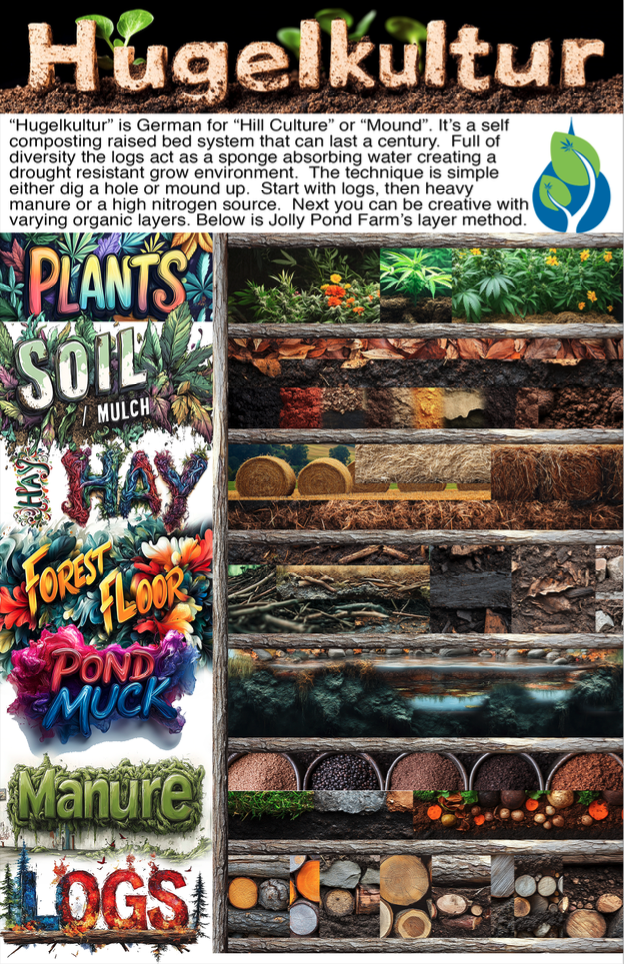
Hugelkulture & Dry farming is our current course of action on most grows.
Creating a Hugelkultur Mound
-
Gather Woody Debris (The Core)
-
Collect large pieces of rotting wood, logs, and thick branches (hardwoods like oak, maple, or fruit trees are best).
-
Avoid woods that inhibit plant growth, like Black Walnut or Black Locust, which contain allelopathic chemicals.
-
Lay the largest logs on the ground to form the base.
- This acts as a sponge and holds water.
-
-
Add Nitrogen and Medium Fill
-
Fill the gaps between the logs with smaller sticks, brush, wood chips, and high-nitrogen materials like grass clippings, leaves, aged manure, or compost.
-
This layer helps decomposition and prevents large air pockets.
-
-
Layer Green and Brown Materials
-
Create successive layers using carbon-rich (“brown”) and nitrogen-rich (“green”) materials.
-
Browns: Dried leaves, straw, any carbon source that is readily available to you. We collect the top layer off the forest floor around our property.
-
Greens: Kitchen scraps, fresh garden debris, grass clippings, any manure source…
-
The goal is to build volume and provide a balanced diet for the soil microbes.
-
-
Top with Soil/Compost
-
Cover the entire mound with a layer of your native soil that you removed earlier, add high-quality garden soil if you’d like, topsoil, or finished compost, combined top soil layer should be at least 1 foot deep, 2 feet would be much better.
-
The final mound should be roughly 3–6 feet high and shaped like a gentle dome or teardrop to shed excess rain while retaining interior moisture if you mound up from the ground. We also dig 2 to 4ft down when creating our mounds so they are more flush with the soil.
- Create swales (ditches) around your mound to help capture water.
-
-
Water,Plant and Mulch
-
Once soaked, the mound is ready for planting. You can sow seeds or transplant seedlings directly into the topsoil layer.
-
Add a final layer of hardwood leaf, straw or wood chip mulch to the surface to retain even more moisture and suppress weeds. Silage tarps are a good option if you want to let the mound rest and breakdown for a season too.
- It can take a year or two for the mound to really flourish.
- Test your soil and make minor adjustments if needed for PH, calcium and other minor imbalances. Use your local ag extension office (affordable testing)
-
Earthworm Casting Compost: we use Mountain Gate Organics, this is one of the few things we out source but well worth it. Incredible addition to our grow.
Compost: made from a variety of material we have on hand.
Hay: sourced from our own 4-acre pasture, no spray.
Clover and Grass Clippings: We bag our grass when mowing the path ways from our property, this is used as a fresh amendment on the plants and doubles as a mulch plus nitrogen source.
Bokashi: is made on site using EM1, with local wheat bran or saw dust.
Below is a list of more KNF (Korean Natural Farming) techniques. While we don’t actively create many of these things anymore we do use maintenance solution as a foliar weekly on most runs.
FPJ (Fermented Plant Juice):
- “FPJ is a fermented extract of a plant’s sap and chlorophylls. It’s a rich enzyme solution full of microorganisms such as lactic acid bacteria and yeast that invigorates plants and animals.”
- We grow Sunflowers along the perimeter of the fence for pollinators. We also use those same sunflowers for making large batches of FPJ and
FFJ (Fermented Fruit Juice):
- “FFJ is made from sweet ripe fruits, vegetables and root crops blended with raw or brown sugar and fermented for a short time. The extract is applied to plants to promote flowering and fruit setting.
- We make FFJ using various vegetables and apples from our 40+ year old trees. After we extract the FFJ, we make vinegar with the leftover fruit. This provides plants with beneficial growth hormones and helps soil microbial life, too.
- We also make a hot pepper ferment that is used in pest management, along with blooming inputs. Leftover peppers are then made into vinegar, as well.
- We also grow luffa for sponges, which also provide large batch ferments for FFJ and vinegar.
LABS (Lactobacillus) Ferments:
- Lactobacilluse: We make our own using rice wash and milk which then allows us to ferment a variety of plants using lactobacillus as the fermentation inhibitor. It’s also great for plant health as a foliar, or root drench. Great compost starter, too.
- Horsetail Ferment: We forage horsetail from our local river (Staunton River). We ferment it using lactobacillus in five-gallon batches.
- Flower Power Ferment: We mix a variety of fruits, such as apples, blackberries and bananas in a 5 gallon bucket. Add one quart of labs and ferment for three weeks. We then strain the material for a nutrient dense solution.
- Yucca Ferments: Yucca grows naturally on our wood line and we harvest the root in the fall and winter to extract the surfactant benefits. Our fermented extract is made using labs mixed with chopped root, fermented under an airlock for a month. We do multiple extractions off the same material that yields a highly valued spreader sticker/surfactant to mix with our nutrients and ipm sprays/ drenches. Yucca extract is a natural wetting agent that helps water and nutrients penetrate deeper into the root zone, producing uniform and even water distribution in foliar applications and helping keep drip lines from clogging.
Fish Amino Acids Ferment: Fish is sourced from the local river and our pond on the property. This is a nitrogen rich source made from one part fish and one brown sugar. Fermented in an airlock container for 1 month, or up to a few years.
Jadam Liquid Fertilizer: mixture of clover, grass, horsetail and common weeds from the property early in the year. Later in the summer we use plantain, Queen Anne’s lace, yarrow, garden scrapes, hemp leaves and other random weeds. We make hundreds of gallons to use as our main root drench fertilizer. These are anaerobic ferments done in multiple 55-gallon barrels.
Indigenous Microorganism (IMO): IMO collections are taken from various spots on the property then IMO4 is cultured using local sawdust and clay from our land. This is used to amend our beds at planting and other times throughout the year to super-charge the microbial life.
Kombucha: made on site to combine with LABS as a foliar spray to help prevent/fight powdery mildew.
KNF (Korean Natural Farming): We make many natural inputs like WCA (water-soluble Calcium) using eggs, WCAP (water-soluble phosphate) using deer bones, EM5 using our own labs, hot peppers and garlic.